
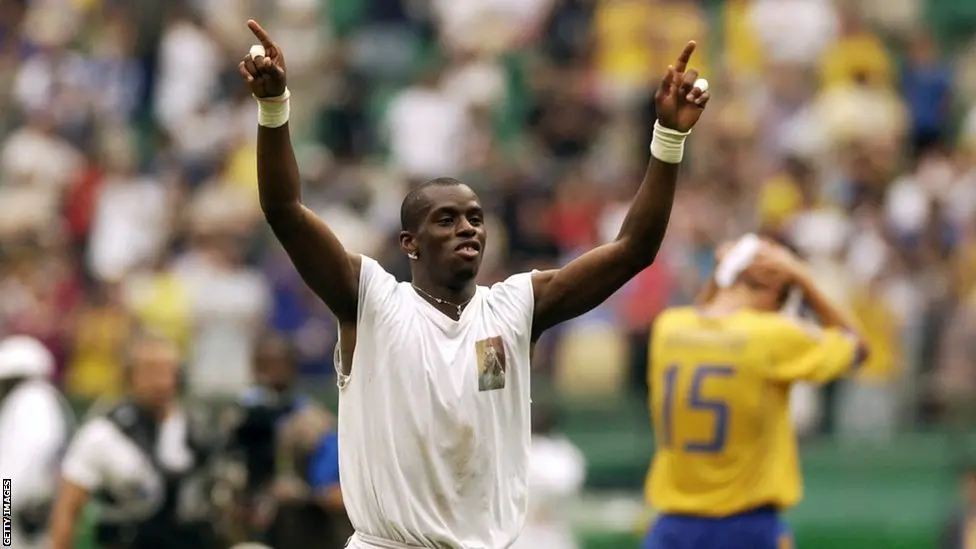
The man who scored the golden goal against Sweden, beat France and wrote himself into World Cup folklore sat down with For Foot Sake ahead of the 2026 tournament. What he had to say about Senegal’s past, present and future was worth every word.
There are World Cup moments, and then there are World Cup moments. Henri Camara has one of the latter. In the summer of 2002, in Oita, Japan, with Senegal trailing Sweden and extra time ticking away, the striker drove a low shot inside the post in the 103rd minute to send his country into the quarter-finals of the World Cup for the first and only time in their history. It was only the second golden goal ever scored at a World Cup. It was, by any measure, one of the greatest moments in African football history.

Now 48, Camara remains one of Senegal’s most beloved figures. The most-capped retired Senegalese international with 99 appearances, he sits second on the all-time scoring list behind only Sadio Mané. With the 2026 World Cup in North America just weeks away, we caught up with Henri to talk about the goal that changed everything, the AFCON controversy that refuses to go away, and whether this Lions of Teranga side can go all the way.
You scored the golden goal against Sweden to send Senegal into the quarter-finals. Over 20 years on, what goes through your mind when you watch that moment back?
“It gives me pleasure, especially since playing in a World Cup was a dream, so scoring the winning goal gives me immense joy.”
Camara had already equalised in the 37th minute that day, dragging Senegal level after Henrik Larsson’s early header. When the golden goal went in deep into extra time, Sweden, who had pushed Senegal right to the wire, hitting the woodwork themselves before Camara struck, were out. And Senegal, in their first-ever World Cup appearance, were in the last eight.
Beating France in the opening game, the defending World Champions, is one of the great World Cup upsets. Did you genuinely believe you could do it going into that match, or did it only feel real when the final whistle went?
“We knew before the match that France were favourites since they were the world champions, but we were physically and mentally ready for them and it gave us the push to win.”
That mental readiness was evident throughout. France, ranked second in the world and arriving as the reigning World and European champions, were expected to swat Senegal aside. Instead, Papa Bouba Diop’s 30th minute goal, a scrappy, glorious, unforgettable tap-in after Barthez spilled a shot, was enough. Senegal held on despite wave after wave of French pressure, Tony Sylva producing save after save. Senegal President Abdoulaye Wade declared a national holiday. The world took notice.
That 2002 squad had a special bond. How much of Senegal’s success today do you think is built on the foundation that generation created?
“The work we did in 2002 inspired a lot of kids in Senegal and Africa to step up and really show that we could do much more on a global scale.”
It is a legacy that is impossible to overstate. Before 2002, Senegal had never appeared at a World Cup. The team that Camara was part of, alongside El Hadji Diouf, Papa Bouba Diop, Aliou Cissé and others, didn’t just compete. They reached the quarter-finals, losing narrowly to Turkey on another golden goal. A generation of Senegalese children grew up believing that anything was possible. Many of those children are now playing for the Lions of Teranga.
Senegal are heading to a World Cup in the USA, Canada and Mexico. How big is this tournament for African football, and specifically for Senegal?
“The World Cup has always been a dream for any player, and Africa always dreams of winning one. They are ready to give anything to win this tournament, just like Morocco in 2022, especially Senegal.”
Morocco showed in Qatar what an African side can do at a World Cup when everything clicks. Camara clearly believes Senegal can pick up where they left off.
In 2002 you shocked the world. Do you think this Senegal squad is capable of going even further, and what would it mean if they did?
“I believe we are able to go all the way. We have a great team and a young coach who has experience in the world, so if we prepare mentally and physically, we should be able to reach the finals.”
From a man who knows what it takes at this level, that is a significant statement of belief in the current generation.
You played across Europe, in England, France, Scotland, Greece. The players in this Senegal squad are spread across the Premier League, Bundesliga, Serie A. Do you think that European experience gives this generation an edge over the 2002 squad, or was there something about that group that money can’t buy?
“I wouldn’t say they have the edge on us, but I will say they are amazing players and what they have done for the country is amazing.”
Read between the lines there. Camara is too diplomatic to say it outright, but the pride in the 2002 generation is evident. The bond and spirit of that squad, forged under Bruno Metsu, a group of players who genuinely believed they could shake the world, is not something that can be replicated simply by having more players at elite European clubs. He gives ground generously on quality. He concedes nothing on spirit.
Senegal won the AFCON final on the pitch against Morocco, only for CAF to overturn the result months later due to the walk-off. As someone who has played in huge international games, what was your reaction when you heard that decision, and do you think it was just?
“Disappointing and surprised, but for me, Senegal will always be the winners. To win you have to prove it on the pitch, and we did. So there’s not much more to say.”
And there it is. Camara isn’t shouting about it, but the message is crystal clear. Senegal won the AFCON final on the pitch. Whatever any committee subsequently decided in an office somewhere is, in his eyes, irrelevant to the football reality. The Lions of Teranga proved it where it matters.
Senegal are appealing to the Court of Arbitration for Sport. Do you believe they will get justice, and what does this whole episode say about the state of African football governance?
“I will not speak much on this — but like I said, Senegal are African champions. That’s all there is to it.”
The restraint here is telling. Camara clearly has strong feelings about the episode, but he is wise enough not to be drawn too far. What he does say, twice, is unambiguous: Senegal are the African champions. That belief runs deep.
Sadio Mané is Senegal’s all-time top scorer and you sit second on that list. What does he mean to Senegal, and how do you think he’ll be remembered when his international career is finally over?
“He is the greatest player in the history of Senegal, so I have immense respect for him. I think Sadio can still play till 42 because he has a good lifestyle.”
High praise from someone who sits just three goals behind him on the all-time list. Camara’s admiration for Mané is genuine and generous, there is no ego in his assessment of where the current icon stands in Senegalese football history.
Players like Pape Matar Sarr at Tottenham, Iliman Ndiaye at Everton and Nicolas Jackson at Bayern Munich are the new generation. Which of the current crop excites you the most, and do you see any of them having the kind of impact you had at a World Cup?
“The players that play like me, such as Ismaila Sarr and the young Mbaye. I also love seeing Sadio play.”
Camara gravitates naturally to the forwards, the quick, direct players who remind him of his own style. Ismaila Sarr in particular has the pace and directness to cause problems for any defence in the world on his day. If Senegal are to go deep in 2026, they’ll need exactly that.
19-year-old Assane Diao chose Senegal over Spain after an international tug-of-war. How important is it that Senegal are now attracting that kind of commitment from young players who had options elsewhere?
“It’s important because now Senegal is a country that people dream of playing for. We have a great group and community, choosing your native country is a great thing for anyone and their families.”
The shift in mentality is significant. That a player talented enough to represent Spain would choose Senegal says everything about how the Lions of Teranga’s status has grown, particularly since their AFCON triumph. The 2002 generation started that journey. The current one is completing it.
You played for Celtic, Wolves, West Ham, Wigan, some very different clubs. Which dressing room taught you the most, and is there one club that still holds a special place for you?
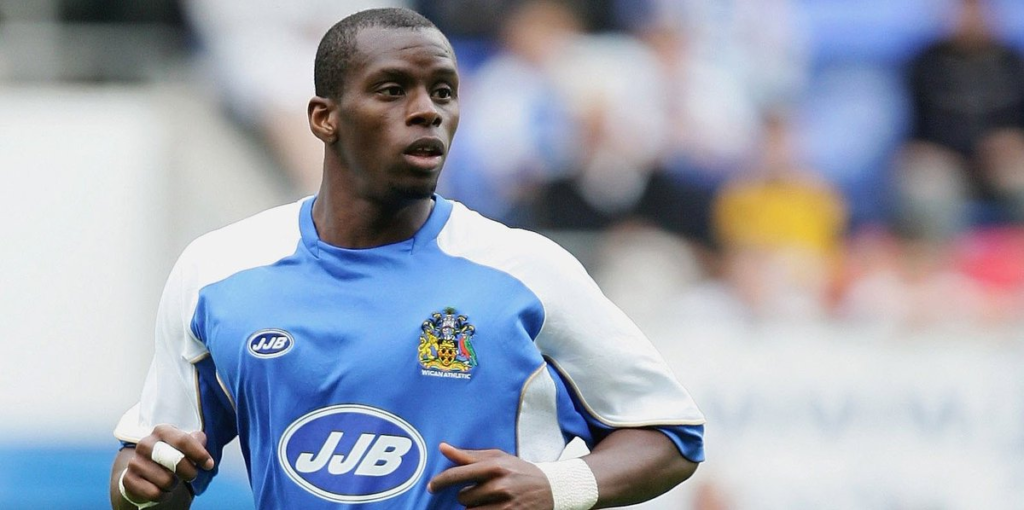
“I spent great times in every team I’ve played, but Wigan and Panetolikos is where I had the best times in my career and made many great memories.”
Wigan will be a popular answer for anyone who remembers his 12 goals in 29 games during their debut Premier League season in 2005-06. The Latics survived relegation on the final day that year with Camara having been a key figure throughout. That Panetolikos, the Greek club where he spent several seasons towards the end of his career, features alongside them says something about the importance of feeling at home and valued at a football club, regardless of level.
El Hadji Malick Diouf is now representing Senegal from West Ham, your old club. Does it give you a sense of pride seeing Senegalese players continuing to make their mark in the Premier League?
“Yes, it’s always a pleasure to see Senegalese players give it their best at the highest level. Senegal has immense talent.”
If you could go back and do one thing differently in your playing career, what would it be?
“It would be to replay the AFCON Final and win it, because we had the players to win it, but luck wasn’t on our side.”
A fitting note to end on. Not a different club move. Not a different decision. Henri Camara’s one regret is that he couldn’t win the AFCON for his country. For a man who gave everything for the Lions of Teranga across 99 caps and 29 goals, it tells you everything about what representing Senegal meant to him — and still means.
With the 2026 World Cup on the horizon and a Senegal side that Camara himself believes can reach the final, there may yet be another chapter to write in this remarkable story.
For further media or business enquiries, please contact F42 Consulting.

Betwinner Review
In this Betwinner review, we look at one of the most recognisable names in global betting, with a platform built…

1xBet Review
This 1xBet review will show why 1xBet one of the biggest names in global betting, and it’s built its reputation…

Stake Review
Stake has become one of the biggest and most recognisable names in global crypto betting, and with 38.8 million customers…